How to Get More Horsepower from a 7.3 Powerstroke: Maximize Engine Output

Featured image for this comprehensive guide about How to get more horsepower from a 7.3 Powerstroke
Image source: slashgear.com
The roar of a 7.3 Powerstroke engine isn’t just a sound; it’s a legacy. For decades, this venerable diesel powerplant has been the backbone of countless Ford trucks, celebrated for its legendary reliability and workhorse capability. But if you’re a proud owner of one of these iconic machines, you likely know there’s more potential lurking under that hood – a desire for more grunt, more towing power, and frankly, more bragging rights. You’re not alone in asking: how to get more horsepower from a 7.3 Powerstroke?
While the stock 7.3L Navistar T444E engine, produced from 1994.5 to 2003, offered impressive figures for its time (ranging from 215 HP and 425 lb-ft torque in early models to 275 HP and 525 lb-ft in later iterations), the march of technology and the ingenuity of the aftermarket have opened up a world of possibilities. Today, it’s not uncommon to see a properly modified 7.3 Powerstroke pushing well over 400 horsepower, and some extreme builds venturing into the four-digit territory. But achieving these gains requires a strategic, informed approach, understanding that true power comes from a harmonious blend of carefully chosen upgrades.
This comprehensive guide will walk you through the most effective strategies and specific modifications to significantly increase 7.3 Powerstroke power. From foundational maintenance to aggressive turbo upgrades, we’ll cover everything you need to know to transform your reliable workhorse into a formidable beast, all while maintaining its renowned durability. Get ready to unlock the true potential of your 7.3 Powerstroke and experience a whole new level of performance.
Quick Answers to Common Questions
How can I quickly and easily get more horsepower from my 7.3 Powerstroke?
The most popular and effective first step is a performance chip or tuner, which recalibrates your engine’s fuel delivery and timing for an immediate boost in power.
Does upgrading my air intake really help my 7.3 Powerstroke gain horsepower?
Absolutely! A high-flow cold air intake allows your engine to breathe much better, feeding it more cool, dense air for improved combustion and a noticeable increase in horsepower.
What role does an aftermarket exhaust play in boosting 7.3 Powerstroke horsepower?
Installing a larger, less restrictive exhaust system significantly improves exhaust gas flow, reducing back pressure and allowing your 7.3 Powerstroke to unleash more of its potential horsepower.
Are upgraded injectors necessary to get serious horsepower from my 7.3 Powerstroke?
For substantial horsepower gains, especially beyond basic tunes, upgraded fuel injectors are crucial as they deliver more fuel to match the increased airflow, maximizing your engine’s output.
What’s a good budget-friendly approach to adding some extra horsepower to my 7.3 Powerstroke?
Start with a performance tuner and a cold air intake; these two modifications offer excellent bang for your buck and provide a very noticeable increase in your 7.3 Powerstroke’s power.
📋 Table of Contents
- Foundation First: Why Maintenance Matters for Power
- Unleashing Potential: The Power of Tuning and Fuel System Upgrades
- Breathing Easy: Air Intake and Exhaust System Enhancements
- Forced Induction: Turbocharger Upgrades for Serious Gains
- Reinforcing the Beast: Transmission and Drivetrain Considerations
- Monitoring Your Investment: Gauges and Engine Health
- Estimated Horsepower Gains from Common 7.3 Powerstroke Upgrades
- Conclusion: Unlocking the Beast’s Potential Responsibly
Foundation First: Why Maintenance Matters for Power
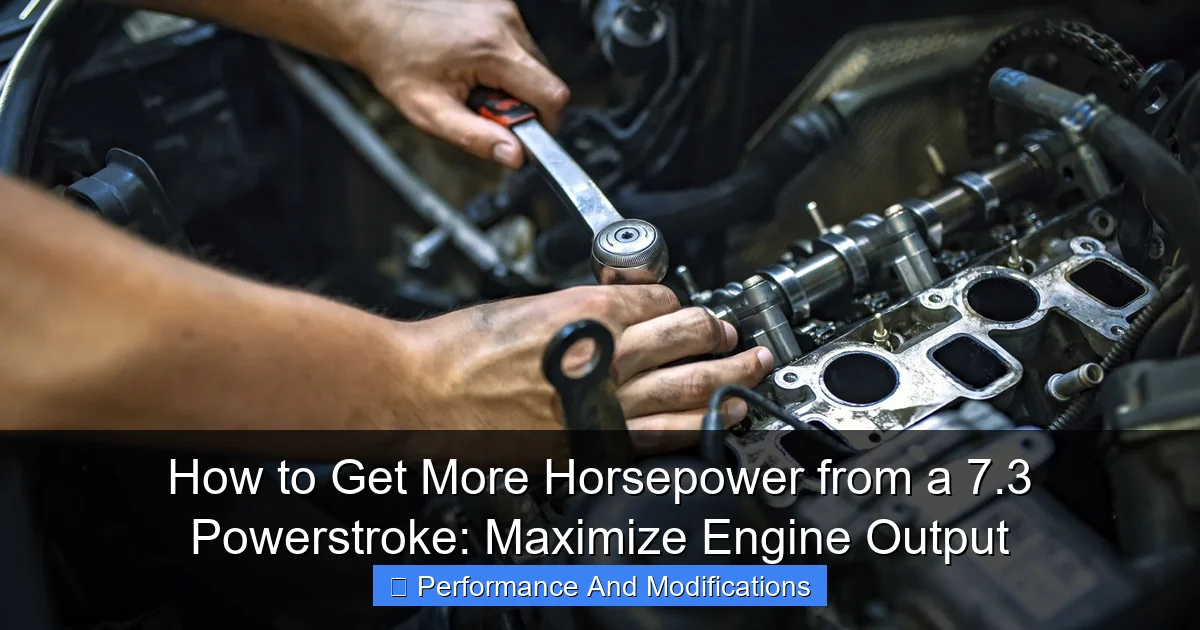
Before you even think about aggressive modifications, let’s talk about the absolute most critical step: impeccable maintenance. Think of it as building a skyscraper – you wouldn’t start with the penthouse before ensuring the foundation is rock solid. A neglected 7.3 Powerstroke will never perform optimally, no matter how many expensive parts you throw at it. In fact, adding power to an unhealthy engine is a recipe for disaster.
Learn more about How to get more horsepower from a 7.3 Powerstroke – How to Get More Horsepower from a 7.3 Powerstroke: Maximize Engine Output
Image source: slashgear.com
Basic Tune-Up Essentials: Filters, Fluids, and More
Ensuring your 7.3 is in peak health means addressing the basics. These aren’t just about longevity; they directly impact your engine’s ability to produce and sustain power efficiently.
| Modification | Estimated HP Gain (Over Stock) | Key Benefit / Impact |
|---|---|---|
| Stock 7.3 Powerstroke (Baseline) | 210-275 HP (Factory) | Reliable factory performance, good towing capabilities. |
| Performance Tuning (Chip/Programmer) | +50 to +100 HP | Optimizes fuel delivery, timing, and boost for significant power and torque. |
| Larger Injectors (e.g., 160cc-238cc) | +80 to +200 HP (Requires custom tuning) | Increases fuel flow, allowing for higher power output; essential for big gains. |
| Turbocharger Upgrade (e.g., larger housing, Wicked Wheel 2) | +40 to +100 HP (With supporting mods & tuning) | Improved airflow, quicker spool, lower exhaust gas temperatures (EGTs). |
| Full Exhaust System (4″ Turbo-Back) | +15 to +30 HP | Reduces exhaust backpressure, improves turbo efficiency, and lowers EGTs. |
- Fresh Fluids: Regularly change your engine oil (using the correct diesel-rated oil), transmission fluid, and coolant. Dirty oil can increase friction, reduce lubrication efficiency, and elevate operating temperatures, all of which hinder power production.
- Clean Filters:
- Fuel Filters: A clogged fuel filter restricts the flow of fuel to your injectors, starving them of the precise volume needed for optimal combustion. This is a common cause of reduced power and rough running.
- Air Filter: Just like a clogged nose, a dirty air filter chokes your engine, reducing the amount of fresh, oxygen-rich air it can draw in. Less air equals less complete combustion and, consequently, less power. Upgrading to a quality aftermarket filter (even before a full Cold Air Intake) can offer marginal gains.
- Oil Filter: Ensures clean oil circulates, protecting vital engine components.
- Glow Plugs and Injector O-rings: Worn glow plugs can lead to hard starts, but more importantly, leaky injector O-rings can cause oil to leak into the fuel system, reducing fuel pressure and diminishing injector performance. Replacing these often restores lost power and improves overall engine operation.
- ICP (Injector Control Pressure) Sensor and IPR (Injector Pressure Regulator) Valve: These are crucial for the HEUI (Hydraulic Electronic Unit Injector) system. A faulty ICP sensor can send incorrect readings to the PCM, leading to incorrect injection pressure, while a failing IPR valve can struggle to maintain the required oil pressure for the injectors. Both significantly impact 7.3 Powerstroke horsepower.
Neglecting these fundamental aspects is like trying to run a marathon on a sprained ankle. Address them first, and you might be surprised by the power you’ve already “found” just by restoring your engine to its intended performance.
Unleashing Potential: The Power of Tuning and Fuel System Upgrades
Once your 7.3 Powerstroke is in tip-top shape, the most significant and immediate gains in 7.3 Powerstroke horsepower come from optimizing how your engine uses fuel and air. This is where electronic tuning and fuel system enhancements truly shine.
Learn more about How to get more horsepower from a 7.3 Powerstroke – How to Get More Horsepower from a 7.3 Powerstroke: Maximize Engine Output
Image source: slashgear.com
The Brains of the Operation: ECU Tuning and Chips
The Engine Control Unit (ECU), or PCM (Powertrain Control Module) in a 7.3, is your engine’s brain. From the factory, it’s programmed with conservative settings to meet emissions standards, accommodate various operating conditions, and ensure longevity for a wide range of users. Aftermarket tuning alters these parameters to maximize performance.
- How Tuning Works: A performance tune adjusts key engine parameters such as:
- Fuel Injection Timing: Optimizing when fuel is injected for maximum combustion efficiency.
- Fuel Pulse Width: How long the injector stays open, controlling the amount of fuel delivered.
- Injector Control Pressure (ICP): Increasing the pressure to atomize fuel more effectively.
- Turbocharger Boost: Allowing the turbo to spool up quicker and provide more boost pressure (within safe limits).
- Transmission Shift Points and Line Pressure: For automatic transmissions, tuning can firm up shifts and optimize gear selection to better handle increased power.
- Types of Tuning:
- Performance Chips: These physical chips plug into your PCM and overwrite the stock programming. Many offer multiple “tunes” (e.g., street, tow, race) that you can switch between.
- Programmers/Flash Tuners: Devices that connect to your OBD-II port to reflash the PCM. Similar to chips, they offer various tunes.
- Custom Tunes: The gold standard. A reputable tuner can write a specific tune tailored to your exact modifications (injectors, turbo, etc.) and your driving style. This yields the safest and most efficient power gains. Brands like DP-Tuner, Swamps Diesel, and Power Hungry Performance (PHP) are highly regarded in the 7.3 Powerstroke community.
Estimated HP Gain: 60-100+ HP (depending on the tune and existing mods). Tuning is often the best “bang for your buck” modification.
Fueling the Fire: Injector and Fuel Pump Upgrades
Once you’ve told your engine to make more power, you need to ensure it has enough fuel to do so. The stock fuel system of a 7.3 Powerstroke can become a limiting factor as horsepower demands increase.
- Larger Injectors: The 7.3 uses hydraulic electronic unit injectors (HEUI). Upgrading to larger injectors (e.g., 160/0, 180/30, 205/30, or even larger) delivers more fuel per injection cycle. This is a primary component for serious 7.3 Powerstroke mods.
- Common Injector Types: Injectors are often described by their flow rate (e.g., 160cc) and nozzle size (e.g., 0% over stock, 30% over stock). More flow and larger nozzles mean more fuel.
- Benefits: Significantly increased fuel delivery for higher power output.
- Considerations: Larger injectors require custom tuning to run correctly and prevent excessive EGTs (Exhaust Gas Temperatures). They also put more strain on the high-pressure oil pump (HPOP).
- High-Pressure Oil Pump (HPOP): The HEUI system relies on high-pressure oil to actuate the fuel injectors. When you install larger injectors, the stock HPOP might struggle to maintain sufficient oil pressure, especially at higher RPMs. Upgrading to a larger, aftermarket HPOP (e.g., an Adrenaline HPOP, Terminator HPOP, or a twin HPOP setup for extreme builds) is essential for consistent fuel delivery with larger injectors.
- Electric Fuel System/Pump: The stock 7.3 uses a mechanical lift pump mounted on the engine, which can be prone to failure and often doesn’t provide consistent fuel pressure for modified engines. Upgrading to an electric fuel system (e.g., FASS, AirDog, or a custom setup) ensures a steady supply of fuel at a consistent pressure to the injectors, preventing fuel starvation and aiding power production. This also often incorporates better filtration.
Estimated HP Gain from Injectors/HPOP/Fuel Pump: 100-300+ HP (highly dependent on injector size, HPOP, and supporting mods).
Breathing Easy: Air Intake and Exhaust System Enhancements
Just as critical as fuel delivery is the engine’s ability to breathe freely. Optimizing airflow into and out of your 7.3 Powerstroke allows for more efficient combustion, lower engine temperatures, and, of course, more power. These upgrades are foundational for any significant horsepower increase.
Optimizing Airflow: Cold Air Intakes (CAI)
A cold air intake system replaces the restrictive stock airbox and tubing with a more free-flowing design and a larger filter. The goal is simple: deliver a greater volume of cooler, denser air to the turbocharger.
- Benefits of a CAI:
- Increased Airflow: Less restriction means the turbo doesn’t have to work as hard to pull in air.
- Lower Air Intake Temperatures (IATs): Cooler air is denser, meaning more oxygen molecules per cubic foot. More oxygen facilitates more complete combustion and therefore more power.
- Improved Throttle Response: Some owners report a noticeable improvement in how quickly the engine responds.
- Enhanced Engine Sound: Many enjoy the deeper, more aggressive intake sound.
- Popular Brands: aFe Power, S&B Filters, K&N, Banks Power are all reputable manufacturers offering high-quality CAI kits specifically for the 7.3 Powerstroke.
Estimated HP Gain: 10-20 HP (more noticeable when combined with tuning and exhaust).
Unrestricted Flow: Exhaust System Upgrades
Just as crucial as getting air in is getting exhaust gases out. The stock 7.3 exhaust system, particularly the downpipe and muffler, can be quite restrictive. Upgrading to a larger, less restrictive exhaust system dramatically improves exhaust gas flow.
- Benefits of an Aftermarket Exhaust:
- Reduced Backpressure: Less restriction means the engine doesn’t have to work as hard to push exhaust gases out, freeing up horsepower.
- Lower EGTs (Exhaust Gas Temperatures): Improved flow helps dissipate heat more effectively, which is vital for engine longevity, especially with increased power. High EGTs are the enemy of a diesel engine.
- Better Turbo Spool: Reduced backpressure allows the turbocharger to spool up faster, reducing turbo lag.
- Aggressive Sound: The signature diesel rumble becomes even more pronounced.
- Common Upgrades:
- 4-inch or 5-inch Turbo-Back Exhaust: Replacing the entire exhaust system from the turbocharger back. A 4-inch system is common for most builds, while 5-inch is for higher-horsepower applications.
- Downpipe Upgrade: The stock downpipe is often the most restrictive part. A larger, mandrel-bent downpipe can offer significant improvements.
- Muffler Delete: For those who want the loudest option, removing the muffler altogether is common, though local noise ordinances should be considered.
- Popular Brands: Banks Power, MagnaFlow, Flowmaster, ATS Diesel, and MBRP are leaders in diesel exhaust systems.
Estimated HP Gain: 15-30 HP (especially noticeable with tuning).
Cooling the Charge: Intercooler Upgrades
An often-overlooked component, the intercooler (or charge air cooler) plays a vital role in 7.3 Powerstroke performance upgrades. The turbocharger compresses air, which heats it up. Hot air is less dense. An intercooler cools this compressed air before it enters the engine.
- Benefits of an Upgraded Intercooler:
- Denser Air Charge: Cooler air means more oxygen enters the combustion chamber, leading to more complete combustion and higher power output.
- Lower EGTs: By cooling the intake charge, the engine runs more efficiently and produces less heat, contributing to lower EGTs.
- Improved Reliability: Cooler running temperatures reduce thermal stress on the engine.
- Considerations: Aftermarket intercoolers typically have larger cores and more efficient fin designs. While not always the first mod, it becomes increasingly important as you add more boost and fuel.
Estimated HP Gain: 10-25 HP (compounding effect with turbo and fuel upgrades).
Forced Induction: Turbocharger Upgrades for Serious Gains
For those truly serious about maximizing 7.3 Powerstroke horsepower, a turbocharger upgrade is almost inevitable. The factory turbocharger (Garrett GTP38) is good, but it becomes a bottleneck once you start pushing significant fuel through larger injectors.
Beyond Stock: Upgrading Your Turbo
A larger, more efficient turbocharger can supply the massive volume of air needed to burn the increased fuel from upgraded injectors, leading to substantial power gains.
- Why Upgrade Your Turbo?
- Increased Airflow: Larger compressor and turbine wheels move more air.
- Higher Boost Pressure: Capable of producing and sustaining higher boost levels safely.
- Improved Efficiency: Modern turbo designs are more efficient, reducing heat and improving responsiveness.
- Types of Turbo Upgrades:
- Compressor Wheel Upgrade (e.g., Wicked Wheel 2): A relatively inexpensive upgrade that replaces just the compressor wheel. It helps with surge and can slightly increase airflow, but it’s not a full turbo upgrade.
- “Early 99” Conversion: Swapping to the turbo from an early 1999 7.3 Powerstroke, which had a slightly larger compressor housing, can offer minor gains.
- Larger Drop-in Turbos: These are turbos designed to fit in the stock location with minimal modifications. Examples include the Garrett GTP38R (ball bearing turbo) or aftermarket options like BorgWarner S300 series variants adapted for the 7.3. These offer excellent power and spool characteristics.
- “Big Single” Turbos: For extreme builds, a custom single turbo setup with a very large turbo (e.g., S400 series) can push insane power, but often requires significant fabrication, specialized tuning, and can introduce more turbo lag.
- Compound Turbos: A complex setup where two turbos work in series (a small one feeding a large one) to provide massive power across a wide RPM range, minimizing lag. This is strictly for high-end competition builds.
- Popular Brands: Garrett, BorgWarner, Pusher Intakes, ATS Diesel, and Full Force Diesel offer various turbo solutions.
Estimated HP Gain: 75-200+ HP (highly dependent on turbo size and supporting mods).
Supporting Mods for Turbo Upgrades
A new turbo isn’t a standalone upgrade. It needs proper support to deliver its full potential safely:
- Bigger Injectors: Essential to supply enough fuel for the increased air.
- Upgraded HPOP: To actuate those larger injectors under higher demand.
- Intercooler: To keep the densely compressed air cool.
- Boost Fooler/Map Sensor: Sometimes needed to prevent the PCM from defueling due to excessively high boost readings.
- EGT Gauge: Absolutely critical to monitor exhaust gas temperatures, especially with a larger turbo.
Reinforcing the Beast: Transmission and Drivetrain Considerations
You’ve added all this glorious 7.3 Powerstroke horsepower, but what’s going to transmit that power to the wheels? The factory transmission (most commonly the 4R100 automatic) and other drivetrain components were designed for stock power levels. Push significantly beyond that, and they become the next weak link. Ignoring this step is akin to putting a Ferrari engine in a bicycle frame – it simply won’t last.
The Weak Link: Transmission Upgrades
For automatic transmissions, increasing torque and horsepower puts immense strain on clutches, bands, and the torque converter. A stock 4R100 typically won’t last long past 350-400 HP, especially if you tow heavily or drive aggressively.
- Upgraded Torque Converter: This is often the first and most crucial transmission upgrade. A stronger, multi-disc torque converter (e.g., billet) can handle more torque and dissipate heat better, preventing slippage.
- Heavy-Duty Clutch Packs and Bands: Replacing the stock friction and steel plates with stronger, higher-capacity aftermarket versions significantly increases the transmission’s ability to hold power without slipping.
- Valve Body Upgrades / Shift Kits: These modify the hydraulic pressure and flow within the transmission, resulting in firmer, quicker shifts. This reduces clutch wear and improves power transfer.
- Full Transmission Rebuild: For serious power (400+ HP), a complete rebuild with all upgraded internal components (input shaft, output shaft, planetary gears, pump, etc.) is often necessary. Reputable builders like Brian’s Truck Shop (BTS), Johnson Valley Performance (JVP), and Randy’s Transmissions are well-known in the 7.3 community.
- Transmission Cooler: Increased power generates more heat. An auxiliary or larger aftermarket transmission cooler is essential to keep fluid temperatures in check, extending transmission life.
Estimated Cost: $2,500 – $8,000+ for a full build, depending on components and builder. This is a significant investment but critical for reliability.
Drivetrain Components: U-Joints, Differentials, and Axles
While the transmission is the primary concern, extreme power levels can start to tax other drivetrain components. For most street-driven trucks under 500 HP, these are often sufficient. However, for dedicated drag racing, heavy sled pulling, or very high horsepower builds:
- Heavy-Duty U-Joints: Stronger universal joints can prevent catastrophic failures under high torque loads.
- Driveshaft Upgrades: A one-piece steel or aluminum driveshaft can sometimes replace a two-piece stock unit for better balance and strength.
- Differential Upgrades: Stronger differential covers, limited-slip differentials, or lockers may be considered for improved traction and durability in extreme conditions.
- Axle Shafts: At the very highest power levels, upgraded axle shafts may be necessary to prevent breakage.
Monitoring Your Investment: Gauges and Engine Health
Adding significant power to your 7.3 Powerstroke without properly monitoring its vital signs is like driving blindfolded at top speed. Gauges are not just for aesthetics; they are absolutely critical for engine longevity and safe operation. They provide real-time data, allowing you to react to potential problems before they become catastrophic and helping you ensure your mods are working as intended.
Essential Gauges for Performance
When you start to boost 7.3 Powerstroke HP, certain parameters become far more critical to monitor than with a stock engine.
- EGT (Exhaust Gas Temperature) Gauge: This is arguably the single most important gauge for any modified diesel. High EGTs are a primary killer of diesel engines, leading to melted pistons, damaged turbochargers, and cracked exhaust manifolds. A probe installed pre-turbo (in the exhaust manifold) gives the most accurate reading.
- Why it’s essential: Tells you how hot the combustion process is. Crucial for tuning and preventing engine damage, especially when towing or under heavy load.
- Typical safe limit: Generally, aim to keep EGTs below 1250-1300°F sustained.
- Boost Gauge: Monitors the pressure your turbocharger is generating.
- Why it’s essential: Helps verify that your turbo is working correctly and not over-boosting (which can be dangerous) or under-boosting (indicating a leak or problem). Also helps you understand when your turbo spools up and its efficiency range.
- Typical range: Stock is around 18-22 PSI. Modified engines can see 30-40+ PSI.
- Fuel Pressure Gauge: Monitors the pressure of fuel being delivered to the injectors.
- Why it’s essential: Ensures your fuel pump and system are adequately supplying fuel. A drop in fuel pressure under load can lead to injector damage, low power, and high EGTs.
- Typical safe range: Generally 60-70 PSI for a healthy 7.3 under load.
- Transmission Temperature Gauge: Especially critical for automatic transmissions, particularly if towing or running significantly increased power.
- Why it’s essential: High transmission temperatures rapidly degrade fluid and accelerate wear on internal components. Knowing your transmission temperature helps you avoid overheating and catastrophic failure.
- Typical safe limit: Keep it below 200-220°F sustained.
- High Pressure Oil (HPO) Gauge: Monitors the pressure within the HPOP system, crucial for injector actuation.
- Why it’s essential: Especially important with larger injectors. Low HPO can starve injectors, causing misfires and power loss.
- Typical range: Varies significantly, but typically 500-3000 PSI depending on RPM and load.
Gauges can be mounted in various locations, such as A-pillar pods, dashboard mounts, or overhead console mounts. Electronic gauge sets (like those from Edge Products or Bully Dog) can also display multiple parameters on a single screen.
Data Logging and Diagnostics
Beyond live gauges, the ability to data log engine parameters can be invaluable for diagnosing issues and refining custom tunes. Many modern tuners and software solutions allow you to record and analyze data from various sensors, providing a deeper insight into your engine’s performance and health. This can help pinpoint fuel pressure drops, boost leaks, or other anomalies that might not be immediately obvious on a live gauge.
Investing in quality gauges and learning how to interpret them is not just an optional accessory; it’s a non-negotiable part of responsible 7.3 Powerstroke performance upgrades. They are your eyes and ears into the health of your modified engine, protecting your significant investment.
Estimated Horsepower Gains from Common 7.3 Powerstroke Upgrades
To help you visualize the potential, here’s a table summarizing estimated horsepower gains from various modifications. Remember, these are approximate and highly dependent on the quality of components, the specific tune, and how well the modifications are matched.
| Upgrade Category | Specific Modification | Estimated HP Gain (Over Stock) | Notes & Considerations |
|---|---|---|---|
| Foundational | Full Maintenance (Filters, Fluids, etc.) | 5-15 HP | Restores lost power, crucial prerequisite. |
| Tuning & Fuel | Performance Tuning (Chip/Programmer/Custom Tune) | 60-100 HP | Best “bang for buck.” Requires healthy engine. |
| Larger Injectors (e.g., 160/0 to 205/30) + Upgraded Fuel System (HPOP, Electric Lift Pump) | 100-250 HP | Requires custom tuning. Higher EGTs likely without other mods. | |
| Air & Exhaust | Cold Air Intake (CAI) | 10-20 HP | Improves airflow, slightly cooler intake temps. |
| 4″ Turbo-Back Exhaust | 15-30 HP | Reduces backpressure, lowers EGTs, improved spool. | |
| Aftermarket Intercooler | 10-25 HP | Denser air charge, lower EGTs, compounds with other mods. | |
| Forced Induction | Larger Drop-in Turbo (e.g., GTP38R, S300 variant) | 75-150 HP | Requires larger injectors and custom tuning. Increased boost. |
| Drivetrain | Built Transmission (for auto) | (No HP Gain) | ESSENTIAL for reliability with increased power. Prevents costly failures. |
| Typical Combination (Moderate) | Tune, CAI, Exhaust, 160/0 Injectors, Electric Fuel Pump | 350-400 HP Total | Great balance of power, reliability, and cost. |
| Typical Combination (Aggressive) | Custom Tune, 205/30 Injectors, Built HPOP, Electric Fuel System, CAI, 4″ Exhaust, Drop-in Turbo, Built Transmission | 450-550+ HP Total | Serious power, requires meticulous monitoring and robust supporting mods. |
Note: These are estimates. Actual results will vary based on the health of your specific engine, the quality of parts, installation, and tuning. Always prioritize a holistic approach, ensuring each upgrade supports the others for optimal performance and reliability.
Conclusion: Unlocking the Beast’s Potential Responsibly
The 7.3 Powerstroke is, without a doubt, one of the most beloved and capable diesel engines ever built. Its inherent durability makes it an excellent platform for modifications, allowing owners to tap into a substantial reservoir of untapped power. By strategically applying the 7.3 Powerstroke mods discussed – from critical maintenance and precise tuning to comprehensive fuel, air, and turbo upgrades – you can transform your truck into a powerhouse that delivers exhilarating performance, whether for towing, daily driving, or simply for the sheer enjoyment of commanding such a formidable machine.
However, the journey to get more horsepower from a 7.3 Powerstroke is one that demands respect for the engineering under the hood. It’s crucial to approach modifications holistically, understanding that each upgrade impacts other components. Never overlook the importance of monitoring your engine’s vital signs with essential gauges, and always consider reinforcing the drivetrain, especially the transmission, to handle the increased torque. Cutting corners on supporting modifications or proper monitoring is a direct path to costly failures.
For optimal results and peace of mind, consider consulting with reputable diesel performance shops or experienced tuners who specialize in the 7.3 Powerstroke. Their expertise can help you choose the right components, ensure proper installation, and dial in a custom tune that maximizes power while preserving the legendary reliability of your engine. Embrace the process, educate yourself, and enjoy the incredible transformation of your 7.3 Powerstroke. The road to maximizing your engine’s output is an exciting one, and with the right approach, your venerable diesel beast will roar louder and pull harder than ever before!
🎥 Related Video: How to Build a 325WHP Ford 7.3 PowerStroke!
📺 8020 Automotive
For all the products listed in this video, visit: https://boostedperformance.com/73-powerstroke Use code “DieselIQ” for 10% OFF …
Frequently Asked Questions
What are the first steps to increase horsepower on a 7.3 Powerstroke?
To begin boosting your 7.3 Powerstroke’s horsepower, focus on foundational “free-flowing” upgrades. Installing an improved cold air intake and a less restrictive exhaust system are excellent starting points, as they allow the engine to breathe more efficiently and set the stage for further modifications.
What are the most effective modifications for significant 7.3 Powerstroke horsepower gains?
For substantial horsepower increases in your 7.3 Powerstroke, custom performance tuning is paramount, as it optimizes fuel delivery and timing. Pairing custom tunes with larger injectors and an upgraded turbocharger will yield the most significant and noticeable power improvements.
Are there budget-friendly ways to get more horsepower from my 7.3 Powerstroke?
Yes, there are cost-effective options to gain horsepower from your 7.3 Powerstroke. A cold air intake system and a performance exhaust are relatively inexpensive ways to improve airflow, while a custom tune, though an investment, offers excellent horsepower per dollar value compared to major hardware changes.
How crucial is custom tuning for maximizing 7.3 Powerstroke horsepower?
Custom tuning is extremely crucial for maximizing 7.3 Powerstroke horsepower and is often considered the best “bang for your buck” modification. It optimizes your engine’s fuel injection, timing, and other parameters to get the most out of your existing hardware and any future upgrades, ensuring efficiency and safety.
Will increasing the horsepower of my 7.3 Powerstroke affect its reliability?
Aggressive horsepower increases can potentially affect your 7.3 Powerstroke’s reliability if not done correctly and responsibly. It’s essential to choose high-quality components, avoid excessively high boost or fuel pressures, and ensure your custom tuning is reputable and conservative enough to maintain engine integrity and longevity.
What role do injectors and turbo upgrades play in boosting 7.3 Powerstroke horsepower?
Injectors and turbo upgrades play a critical role in significantly boosting 7.3 Powerstroke horsepower by providing more fuel and air. Larger injectors deliver the necessary extra fuel for higher power, while an upgraded turbocharger supplies the increased volume of air required to efficiently burn that fuel, creating a more potent combustion.